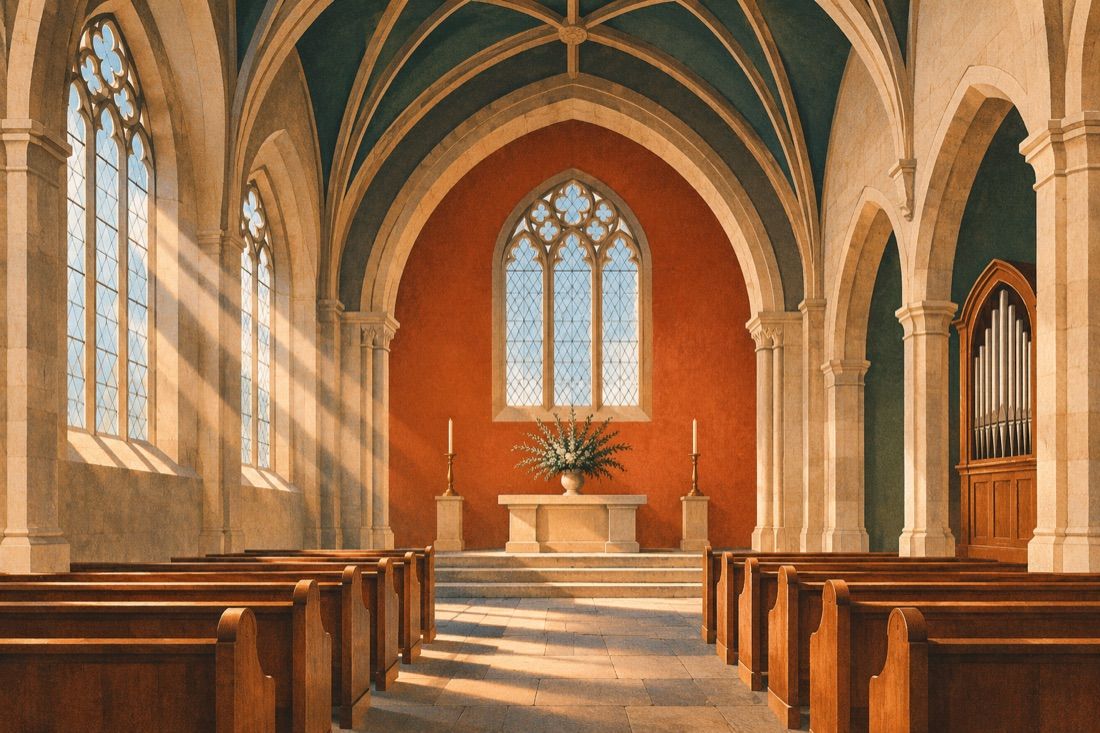
Why churches sound the way they do
Sound in a room is the direct sound from the singers plus thousands of reflections off walls, floor and ceiling. In a church with hard stone, plaster, glass and polished wood, little of that energy is absorbed, and the reflections keep arriving for a long time. High vaulted ceilings add volume, which lengthens the effect further.
The result is the familiar glow of choral music in a church: voices blend, long notes seem to hang and organ chords fill the building. Many composers wrote with such spaces in mind, which is part of why sacred choral music often works well there.
What reverberation time means
The usual measure is reverberation time: how long it takes a sound to fade by 60 decibels after the source stops. Wallace Clement Sabine, the physicist who helped design Boston Symphony Hall in 1900, showed that the time depends on the volume of the room and the amount of absorption in it. Bigger and harder means longer.
Commonly cited targets for concert halls are around one and a half to two seconds, and a large stone church can be well beyond that, so that sound lingers for several seconds when the building is empty. Speech needs a much shorter time to stay clear, which is why a sermon and a motet make opposite demands on the same space.
Common problems for choirs and audiences
In a very reverberant church the problems are predictable. Fast passages and consonants smear into each other, words become hard to follow, quiet entries are masked by the tail of the previous chord and the sound can be unclear in the back rows or far from the chancel. Singers may also find it hard to hear each other, which makes tuning and ensemble more difficult.
The opposite problem exists too. A modern church with carpet, thick curtains and acoustic tiles can be so absorbent that choirs feel they are singing into a wall. This is what people mean when they ask how to improve choir sound in a dead acoustic church.
Practical ways to work with a live room
Most fixes are about musical choices, not equipment. Slow the tempo a little, shorten the gaps between phrases less than you would in a dry room, give consonants a clearer start and leave a longer pause after a final chord. Choose repertoire to suit the room: long-line polyphony and chant tend to flatter a stone church, while fast, rhythmic pieces may suit a drier space better.
Try the choir in different positions. Moving a few metres forward, standing in a tighter formation, singing from the crossing or the side aisle can change both the sound the audience hears and what singers hear of each other. Have a trusted listener sit in several places during rehearsal and report back, because the sound at the conductor's position is often not typical.
Church acoustic treatment and sound systems
When a room is too live or too dead for its main use, acoustic treatment can help. Added absorption such as panels or curtains shortens the reverberation, while hard reflective surfaces placed near the performers send sound towards the audience. Large changes are a job for an acoustic consultant, as they affect how the room works for worship, speech and music together.
Church sound systems are usually designed for speech. Used for a concert they can make a live room worse, because amplified sound feeds the reverberation. If a choir is singing acoustically, ask whether the system can stay off, and read the booking guide for what to confirm about equipment.
Planning a choir concert in a church
Visit the church with the choir and sing in it before you commit, with chairs and risers set as they will be on the night. Plan for the audience being present: people absorb sound, so a full church is less reverberant than an empty one. Ask about heating, lighting, access, toilets and the church's own calendar.
Then build the programme and the running order with the room in mind, as described in the guide to planning a concert series. For halls designed for music, compare the notes in concert hall acoustics.