A plain definition
Chamber music is classical music written for a small ensemble in which each player has their own part. There is usually no conductor, and the players listen to each other and shape the music together. What qualifies as chamber music is not fixed at the edges, but a duo, a trio, a quartet, a quintet and up to an octet or so are the usual range.
The line from the orchestra is clear in principle. An orchestra has many players on each string part and a conductor. A chamber group has one player per part, and every voice can be heard as an individual line.
Why is it called chamber music?
The name goes back to the Italian term for music of the chamber, as opposed to music of the church or of the theatre. In the baroque period, writers separated music for church from music for the court's rooms and from opera. Chamber music was meant to be played in a room, for the players themselves or for a small audience.
That origin still shapes the genre. It suits close listening in small spaces, which is why it fits so well with the kind of rooms discussed in the guide to concert hall acoustics.
Common ensembles
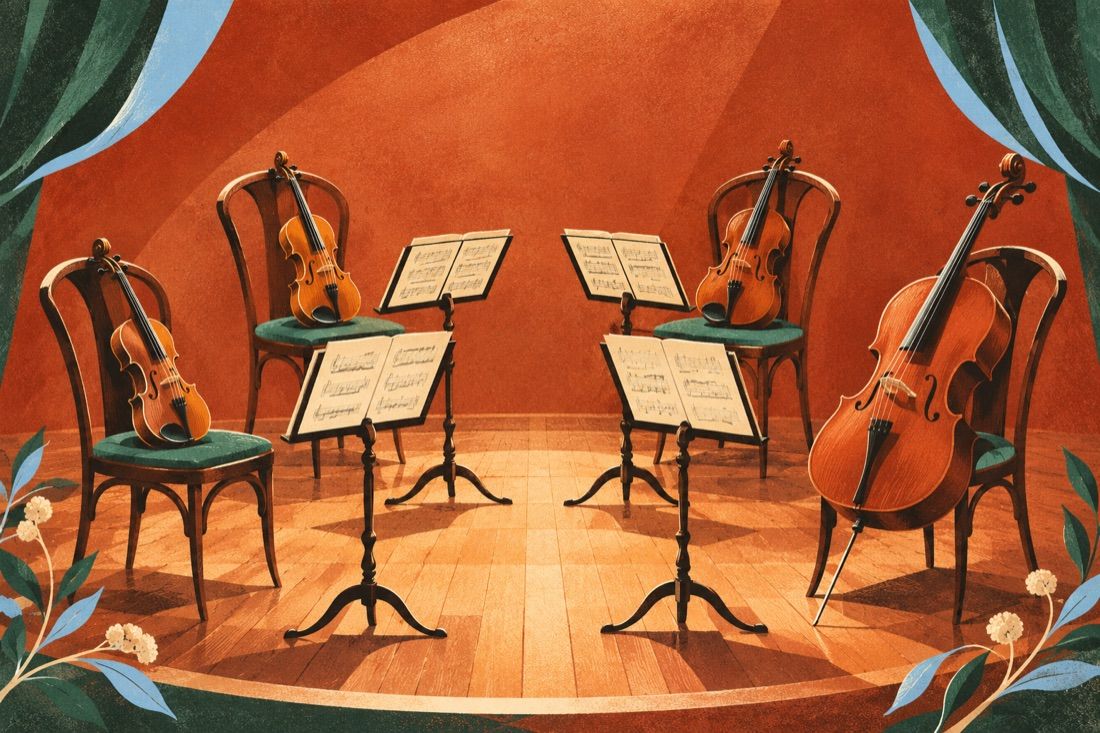
The string quartet, two violins, a viola and a cello, is the best known group, and Joseph Haydn is often called the father of the string quartet because of the many he wrote in the second half of the 1700s. A piano trio has a piano, a violin and a cello. A piano quintet adds a string quartet to a piano. Wind quintets, brass groups, and mixed ensembles that use a piano or a harp also belong here.
A string quartet concert is among the easiest chamber events to put on, because the four players travel light and need only chairs and stands. Check the room, and what to ask a venue, in the booking guide.
Chamber music versus orchestra, and the chamber orchestra
People often ask about the difference between a concert and chamber orchestra, or between chamber music and an orchestra. The practical differences are size and leadership. An orchestra uses dozens of players and a conductor, and the sound is built for larger rooms. A chamber orchestra is a smaller orchestra, with fewer strings in each section, and it usually still uses a conductor. A chamber ensemble plays with one musician to a part.
This changes how music is made. In a quartet, the musicians decide on tempo, balance and phrasing through eye contact and listening. For that reason, many players treat chamber music as the most direct kind of ensemble playing.
What to expect at a chamber music concert
Expect a smaller venue, a shorter programme than a symphony evening and a mix of pieces from different periods, often with a modern work next to a classic. Some ensembles speak to the audience between pieces and many provide programme notes. The seating is often close to the players, so you can see how they cue one another.
The customs are described in the guide to classical concert etiquette. If you are new to it, start with a programme that mixes familiar names with something unfamiliar, and give the music a chance.
From listener to organiser
A chamber concert is a good first event for a new organiser because the forces are small and the audience is likely to be too. Choose a room with good intimacy, set a clear date and plan a short run if it goes well. The next step is the guide to planning a concert series.
Whatever the programme, tell the audience what they will hear, how long it will last and when to applaud. A good evening starts with clear information.