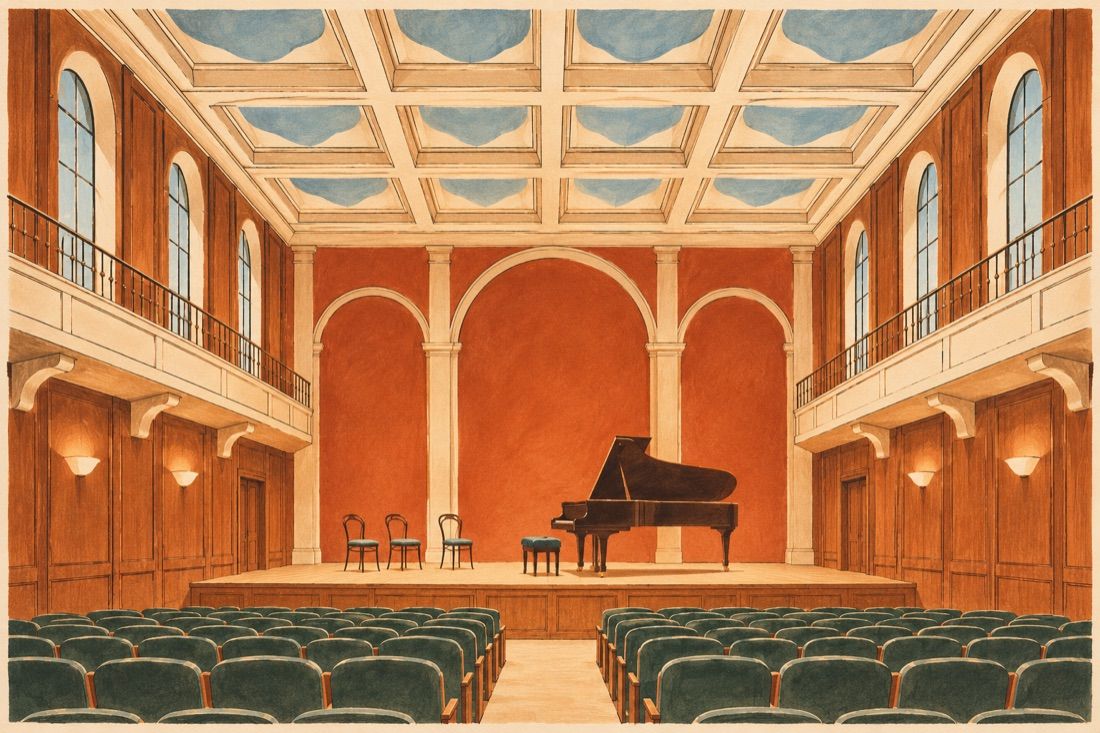
What good concert hall acoustics means
Acousticians describe a good music room with several qualities rather than one number. The sound should be loud enough without strain, clear enough to follow detail, warm enough that low notes are full, and enveloping, so that the listener feels surrounded by the sound instead of hearing it from a distance. Balance matters too: the ensemble should sound like one, with no instrument buried.
The typical acoustics of a concert hall are therefore a compromise. Longer reverberation suits large romantic orchestral music, while shorter, drier rooms suit speech, amplified music and fast chamber playing. No hall is perfect for everything.
Reverberation and the effect of an audience
Reverberation time is the main measure and depends on the room volume and the absorption inside it, as set out in the Sabine formula from the early 1900s. Audience seating matters a great deal because people and upholstered seats absorb sound. A hall that sounds lively in an empty rehearsal can sound drier when full, which is why designers pay attention to the seats.
For a small recital room the lesson is practical: test the room with people in it if you can, or allow for the change. Rooms with bare floors and walls and few seats are more lively than they will be on the night.
Shoebox, fan and vineyard shapes
Hall shape affects how reflections reach the audience. A shoebox hall is a long, narrow rectangle with parallel side walls and a high ceiling. The side walls send early reflections to listeners from the sides, which many people associate with a sense of envelopment. The Musikverein in Vienna from 1870, the Concertgebouw in Amsterdam from 1888 and Boston Symphony Hall from 1900 are famous shoebox rooms.
In the fan shape the walls spread out behind the stage, which gives more seats close to the performers but can lose some of those side reflections. In vineyard halls, the audience sits in terraces around the stage. The Berlin Philharmonie, opened in 1963, is the best known example. None of these shapes guarantees good sound, because details such as surfaces, ceiling height and balcony depth also matter.
Small recital rooms are their own case
A recital hall for a few hundred people, or a room for fewer than a hundred, behaves differently from a large symphony hall. Distances are short, so the direct sound from a piano or a string quartet is strong and detailed, and the room has less time to build a long reverberant tail. Too much absorption makes the music feel flat. Too many hard parallel surfaces can cause flutter echoes, a rapid ringing between two walls that is easy to hear after a handclap.
Small rooms with a regular rectangular shape can also have uneven bass, with some notes booming at some seats and weak at others. Wood panelling, diffusing surfaces such as relief on walls and a ceiling that is not too low all help.
How to test a room before you book it
Clap once sharply in the empty room and listen to how the sound dies away. A short, dull clap suggests a dry room, a long ring suggests a live one and a rattle between the walls suggests flutter echo. Then have a friend speak or play a few notes on stage while you walk around the audience area and sit at the back, at the sides and under a balcony.
Listen for clarity as well as loudness, check that people can hear the stage from every area and notice background noise from heating, traffic or neighbouring rooms. Our guide to booking a venue lists the other questions to ask during the same visit.
Matching the room to the music
String quartets and piano trios, described in the guide to what chamber music is, usually favour rooms that are intimate and not too reverberant, so detail survives. Choirs, as the article on church acoustics explains, often enjoy more reverberation, though not at the cost of the words. Amplified groups generally need a drier room.
If two rooms both fit your budget, which you can compare using the rental cost guide, choose the one that suits the music.