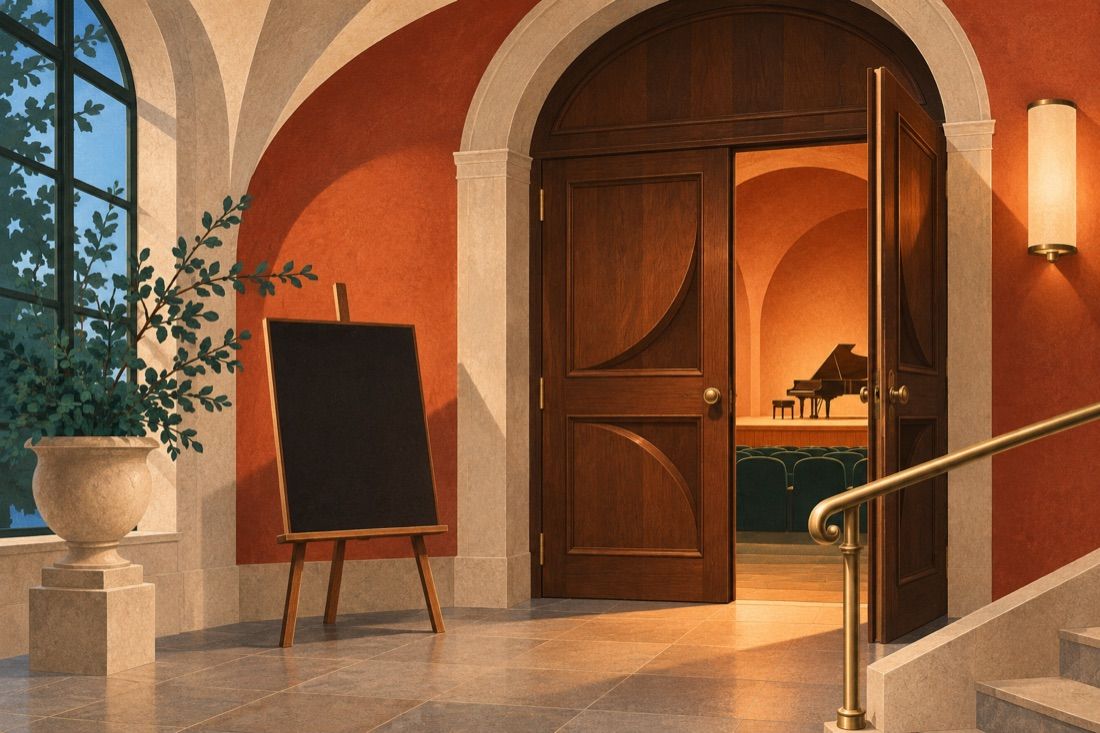
Start with the music, then pick the room
Before you contact anyone, write down what you are putting on: the ensemble size, whether it is amplified, whether you need a piano, how long the programme runs and how many people you realistically expect. A solo recital, a string quartet, a gospel choir with a rhythm section and a school concert place very different demands on a room.
This is also how to select a venue for an event in plain terms. Match the room to the sound and the audience, not the other way round. A hall that is too large makes a small crowd look lost, and a room that is too small turns every extra ticket into a problem. The acoustics guide explains why the same ensemble can sound warm in one space and thin in another.
Where small concerts actually happen
Small concerts rarely live only in purpose-built halls. They happen in recital rooms attached to music schools, in churches and meeting houses, in libraries, community centres, galleries, arts centres, bars with a stage and, increasingly, in living rooms as house concerts. Each type comes with a different set of rules.
Churches often suit choirs and chamber music because of their reverberant sound, and some welcome outside events. See church acoustics for choirs before you decide. Schools and universities may hire rooms to outside groups, usually outside term-time teaching hours. Bars and clubs usually think in terms of drinks sales and late evenings, which may not suit a quiet recital.
How to approach a venue with a booking request
Venues receive many requests, so the best ones are short and complete. Name the group and the type of music, give two or three possible dates, state the expected audience size, say whether the event is ticketed, free or by donation, and link to a recording or a clear description of the programme. Ask who handles bookings and what the process is, rather than guessing.
Be honest about what you are asking for. A venue deciding whether to programme you is different from a venue you simply hire for a night. In the first case the venue chooses acts, sets the date and often shares the door income. In the second you pay for the space and run the event yourself. Ask which one applies before you spend time on posters.
What to ask before you hold a date
Treat the first visit as an inspection. Check the capacity set for the room, the number of exits, step-free access to the stage and the toilets, and where an audience member in a wheelchair would sit. Ask what is included: chairs, music stands, a piano and whether it is tuned, lighting, a sound system and a person who can run it.
Ask about the practical timetable too: when you can load in, how long you have for a sound check or rehearsal, when doors may open and when the room must be empty. Ask who sets up the chairs and who resets the room afterwards. Many disputes come from an unstated hour at the end of the evening.
Free venues and what they really cost
People often ask how to get a free venue for an event. Some libraries, community halls, churches and schools offer a room at no charge or for a donation to community groups, especially for non-profit or educational events. The honest answer is that free rarely means no conditions: you may have to accept set times, supply your own insurance or follow strict rules on food, decorations and noise.
If a room is free, ask what the costs are elsewhere, such as a caretaker's hours, cleaning, parking or heating. The article on how much it costs to rent a concert hall lists the cost lines to compare.
Put it in writing
Once a date is agreed, get the basics confirmed in an email or a short agreement: date and times, the space you may use, the fee or the split, what the venue provides, who pays for what, the cancellation terms on both sides and any insurance requirement. If the venue or the event requires music licences, find out who holds them.
Keep a one-page running sheet for the evening and share it with the venue contact. Then keep promoting. A booked room is only the start, and the planning steps for a run of dates are in the guide to planning a concert series.