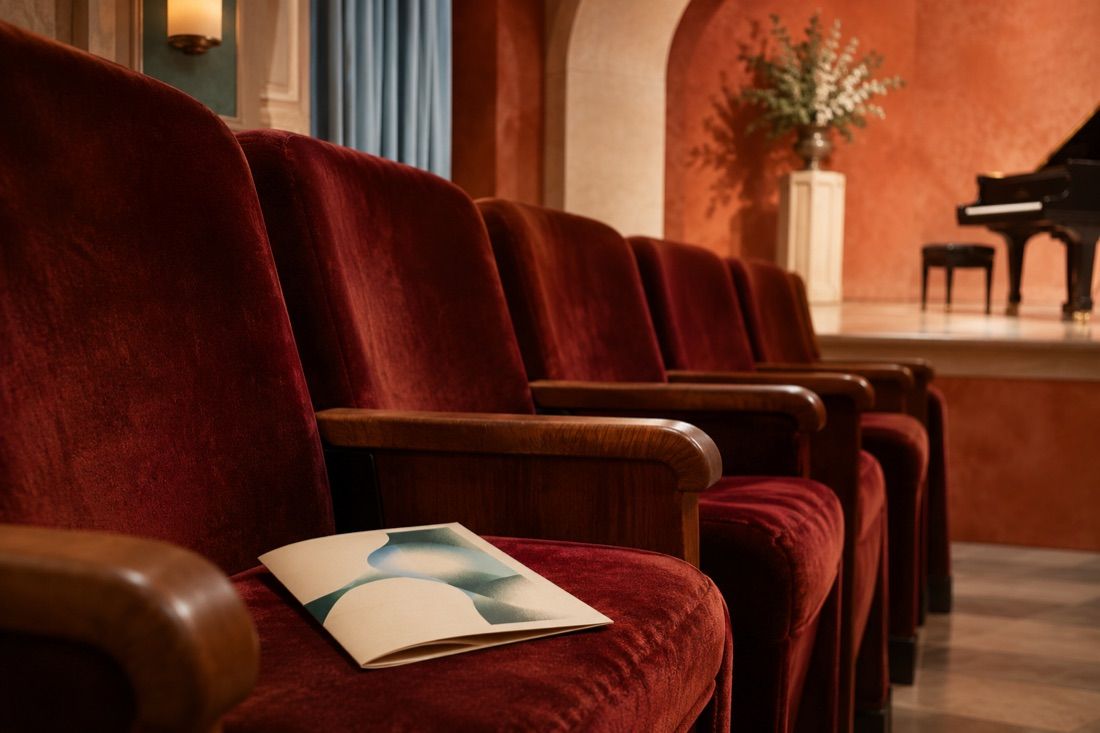
The idea behind concert manners
A concert room is built for listening. Quiet passages can be very quiet, and in a small hall a cough, a rustle or a phone is heard by everyone, including the performers. Most customs follow from that: arrive in time, keep noise low and let the music finish before you react.
Because the customs are conventions, they differ between places and types of event. A formal recital, a church concert, a community choir evening and a gospel concert each have their own norms. When in doubt, watch the audience and the performers.
When to clap at a classical concert
At most formal classical concerts, the custom is to hold applause until the end of a complete piece, not between its movements. A symphony, a sonata or a quartet often has several movements, and the silence between them is part of the shape. If you are unsure whether a piece has ended, wait until the performers lower their instruments or the conductor lowers their arms and turns to the audience, or until others begin to clap.
This is a convention rather than a rule, and it has not always applied. In earlier centuries audiences often reacted during a piece. Many ensembles today are relaxed about a burst of applause after a movement, and nobody should feel embarrassed. A short pause is the safe choice at a first visit.
Arrival, phones and photographs
Aim to arrive early enough to find your seat before the start. Latecomers are usually asked to wait until a pause between pieces, and some venues do not admit them until the interval. Switch phones off rather than to silent, because a vibrating phone can still be heard in a quiet room. Check the venue's policy on photography and recording. Flash is rarely welcome, and many venues do not allow recording at all.
If you need to cough, try to do so during a loud passage or between movements, and keep unwrapped sweets and a programme you can turn quietly. Children are welcome at many concerts, especially family events, and the best choice is a seat near an aisle.
What to wear and how long a concert lasts
There is no universal dress code. Many small venues and choir concerts are casual, with people dressing as they would for a nice evening out, and some formal occasions suggest smarter clothes. Comfort matters because you will be sitting still. If the invitation or the venue states a dress code, follow it.
How long a classical concert lasts depends on the programme. A typical evening has two halves separated by an interval, with music for roughly an hour to an hour and a half in total, though recitals, lunchtime concerts and family events can be much shorter. Check the printed length if one is given.
Choral, church and gospel concerts
Etiquette changes with the setting. In a church, people often keep applause for the end or follow the cues of the performers, since the space may also be used for worship. Some choirs ask the audience not to clap at all in a sacred programme, and the programme will usually say so.
Gospel concerts come from a tradition in which the audience takes part, so clapping, singing along and moving to the music are often invited. Follow the lead of the choir and the leader, and if participation is welcome you will be told. When in doubt, ask the organiser beforehand.
Being a good listener in a small room
Small venues make the audience part of the sound. Sit where you can see the performers, keep bags out of the aisle, do not talk during the music and, if you must leave, wait for a pause. Read the programme notes before the music starts rather than during it.
The reward is a closer kind of concert. For what you might hear, read the introduction to chamber music. If you organise events yourself, put your customs in the programme, which is part of planning a concert series.